
The Eye of Life, 2021
Participatory land art, Mangrove saplings, name tags, public donations and planting, Tielugang Mangrove Nature Reserve, Haitang Bay, Sanya, Hainan, China
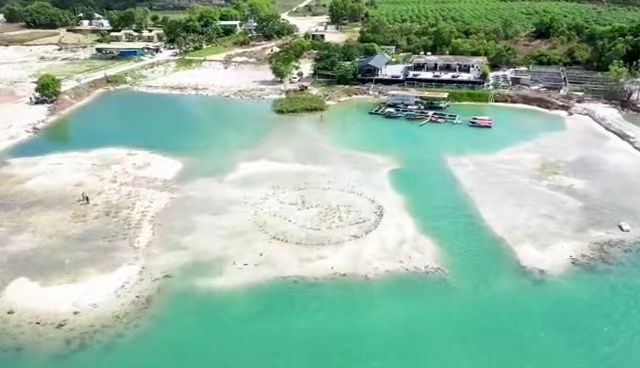
The Eye of Life is a participatory land art project created by Fang Ting Ting in 2021 at Tielugang Mangrove Nature Reserve in Sanya, China. Working with an existing mangrove restoration programme, Fang arranged publicly donated mangrove saplings in the shape of an eye in the intertidal zone. Trees donated under participants’ names were given name tags. Individual contributions came together to form an image that could only be seen in full from the air. They also connected participants to a growing coastal habitat. The work brings marine restoration together with Fang’s reflections on life: can a person’s actions continue to have an effect after they have left?
Artist’s Note
After losing many of my early artworks, I began looking for forms of art that did not depend on people to preserve them. Land art opened up the possibility of a work continuing through growth and change in the natural environment, without having to retain its original form.
After founding a charitable foundation in Hainan in 2019, I organised beach clean-ups, marine animal releases and other charitable projects. Through this work, I came across an existing mangrove restoration programme in Tielugang. I learnt how mangroves protect coastlines and provide habitats for many species. I then began planning a participatory art and charity project through which individuals could help restore the marine environment.
Faced with vast environmental problems, people can feel that their actions make little difference. I wanted each participant to have a link to this coast that they could recognise. I introduced a way for people to donate a tree under their own name, with a name tag attached. Those unable to attend received a photograph of their tag. They could return later to find their tree. Their donation would have a living form that could continue to grow.
The shape of the work came from my thoughts about life and human actions. The way people describe themselves does not always match what they have done. I imagined the pineal gland as a third eye, a “light-powered camera” that continuously records a person’s actions. This was a personal spiritual image. Each mangrove sapling stood for one action. Together, they formed an eye. I wanted to bring the way we treat our own lives and the way we treat our shared planet into the same work. I chose to present it on 20 May, a date associated with love in China, to extend that expression of love from other people to the natural environment.
Planting had to follow the tides and allow enough space for the mangroves to grow. The planned group planting could not go ahead as intended. Both methods we had prepared to mark out the shape also failed on site. A few collaborators and I used bamboo poles, string and a simple compass to measure and plant through the night. I first saw the complete eye when the drone rose the following morning.
Donations and planting continued afterwards, growing into a public environmental initiative involving more people. I plan to return every ten years to record the changes from the air. Trees will grow. Some may die and be replaced. The outline of the eye may gradually blur and merge into the surrounding mangroves. These changes are part of how I imagine the work’s future. I hope art can give more people a reason to act, and that the trees they donate or plant will keep growing after they leave, as part of a work they have helped create.

Master plan of the Tielugang Mangrove Nature Reserve, Sanya, showing the proposed site for The Eye of Life. Provided by the project planners.

A name tag attached to a mangrove sapling as part of The Eye of Life.

Fang Ting Ting and her companions planting mangrove saplings in the sea at night.
Photos: Chen Jie, 2021